
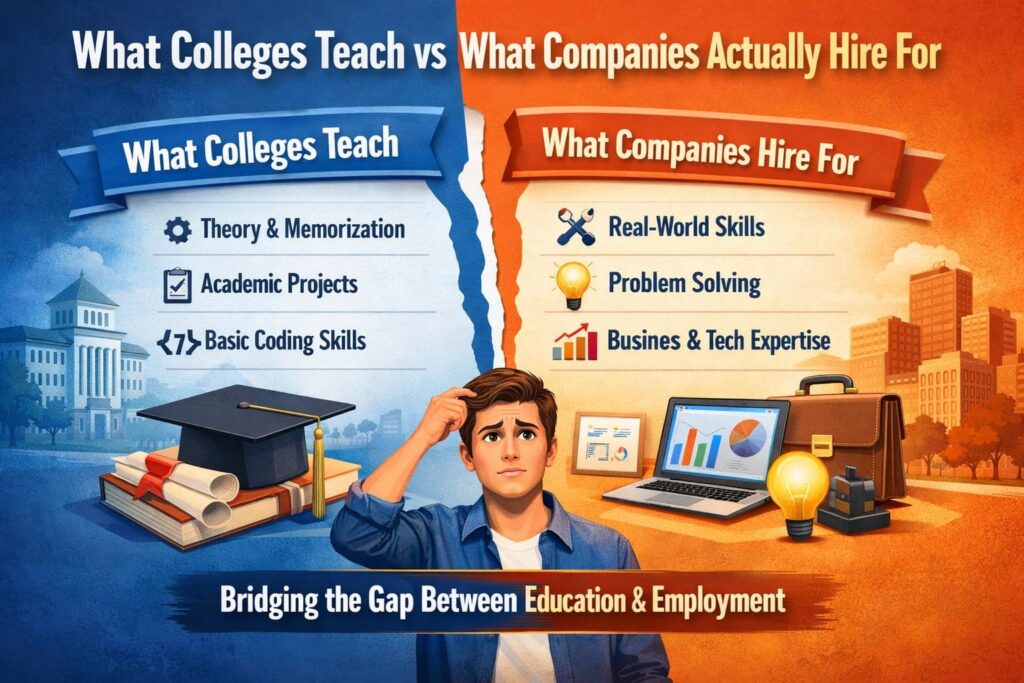
The Growing Disconnect: What Colleges Teach vs What Companies Actually Hire For
Recent graduates and career switchers often discover a harsh reality after landing their first interviews: the skills gap between education and employment runs deeper than anyone warned them about.
Who this guide helps: Students preparing for the job market, recent graduates struggling to land positions, and career changers wondering why their credentials aren’t opening doors.
You’ll learn why academic learning vs job requirements creates such a mismatch, and more importantly, what you can do about it. We’ll break down the essential skills companies hire for that rarely show up in course catalogs, from the technical skills employers need right now to the soft skills for career success that can make or break your interview performance.
We’ll also explore specific industry competencies missing from education and give you a roadmap for bridging the education employment gap before it derails your career plans.
The good news? Once you understand what companies want vs what colleges teach, you can start building the right skills while you’re still in school—or fill those gaps quickly if you’ve already graduated.
The Growing Skills Gap Between Academic Learning and Industry Needs
Why traditional curriculum development lags behind market demands
University curriculum committees move at a glacial pace compared to industry innovation. While companies can pivot their skill requirements within months, academic institutions often take 3-5 years to approve and implement new programs. This lengthy approval process involves multiple stakeholders, from faculty committees to accreditation boards, creating a bureaucratic maze that stifles rapid adaptation.
The college vs industry skills mismatch becomes obvious when you consider how universities prioritize academic research over practical application. Professors often lack recent industry experience, having spent decades in academic environments. Their expertise centers on theoretical frameworks that may have lost relevance in today’s fast-moving job market.
Budget constraints compound the problem. Universities can’t constantly overhaul expensive lab equipment or software licenses to match current industry standards. Students learn on outdated systems while companies use cutting-edge tools, creating an immediate disconnect upon graduation.
How rapidly evolving technology outpaces educational updates
Technology companies release new frameworks, programming languages, and methodologies quarterly. Cloud computing platforms update features monthly. Meanwhile, textbooks take years to publish, and by the time students graduate, the specific technologies they learned may already be obsolete.
The skills gap between education and employment widens particularly in tech fields where companies adopt artificial intelligence, machine learning, and automation at breakneck speed. Students graduate with knowledge of programming languages that employers no longer prioritize, while missing exposure to emerging technologies driving current hiring decisions.
Consider data science programs that still teach primarily R and basic Python when companies now expect proficiency in specialized libraries, cloud platforms, and real-time data processing tools that didn’t exist when the curriculum was designed.
The disconnect between theoretical knowledge and practical application
Students spend semesters studying business theories but never manage actual budgets, timelines, or stakeholder expectations. Engineering students solve textbook problems with clear parameters while real-world projects involve ambiguous requirements, changing specifications, and resource constraints.
What companies want vs what colleges teach becomes starkest in project management scenarios. Academic group projects typically last weeks with predetermined outcomes, while workplace projects span months with evolving goals and cross-departmental dependencies.
The academic learning vs job requirements gap shows in everyday workplace situations:
| Academic Experience | Industry Reality |
| Individual assignments with clear rubrics | Collaborative projects with shifting priorities |
| Theoretical case studies | Real client relationships and consequences |
| Semester-long timelines | Daily deadlines and deliverables |
| Grade-based feedback | Performance reviews and business impact metrics |
Students graduate understanding concepts but struggle with execution, client communication, and the messy realities of workplace dynamics that textbooks can’t capture.
Essential Technical Skills Companies Actually Want
Programming Languages and Frameworks That Drive Real Business Value
Companies need developers who can work with languages and frameworks that directly impact their bottom line. While colleges often focus on foundational languages like Java or C++, the job market demands expertise in JavaScript, Python, and React for web development, along with cloud-native technologies like Node.js and Docker containers.
Modern businesses prioritize full-stack developers who understand both frontend and backend development. JavaScript frameworks like React, Vue.js, and Angular dominate hiring requirements, while Python drives data science and automation initiatives. Companies also seek professionals familiar with database technologies like PostgreSQL, MongoDB, and Redis for handling real-world data challenges.
Mobile development skills remain crucial, with Swift for iOS and Kotlin for Android leading employer preferences. DevOps capabilities using tools like Jenkins, GitLab CI/CD, and Kubernetes separate candidates who can deploy code from those who just write it.
Data Analysis and Interpretation Capabilities for Decision-Making
Every modern company needs employees who can turn raw data into actionable insights. SQL proficiency stands as the most requested technical skill across industries, yet many college curricula barely scratch the surface of database querying and optimization.
Excel mastery goes beyond basic spreadsheet functions. Employers want professionals who can create pivot tables, use VLOOKUP and INDEX-MATCH functions, and build dynamic dashboards. Advanced Excel skills often prove more valuable than theoretical statistics courses.
Data visualization tools like Tableau, Power BI, and Google Analytics help companies understand customer behavior and market trends. Python libraries including Pandas, NumPy, and Matplotlib enable deeper analysis that drives strategic decisions. R programming skills open doors in healthcare, finance, and research-heavy industries where statistical modeling directly influences business outcomes.
Digital Literacy and Automation Tools That Increase Productivity
Companies desperately need workers who can automate repetitive tasks and streamline workflows. While colleges teach theoretical computer science concepts, businesses want people who can use tools like Zapier, Microsoft Power Automate, and Google Workspace scripts to eliminate manual processes.
Project management platforms like Asana, Jira, and Monday.com have become essential workplace tools. Marketing automation through HubSpot, Salesforce, and email marketing platforms drives revenue growth that companies can measure immediately.
No-code and low-code development platforms like Bubble, Webflow, and Airtable allow non-technical employees to build functional applications. These skills help bridge the gap between IT departments and business needs, making employees valuable across multiple departments.
Cloud Computing and Cybersecurity Fundamentals for Modern Operations
Amazon Web Services (AWS), Microsoft Azure, and Google Cloud Platform power modern business infrastructure. Companies need employees who understand cloud deployment, serverless functions, and container orchestration. Cloud certification programs often carry more weight with employers than traditional computer science degrees.
Cybersecurity skills have become non-negotiable across all industries. Basic security protocols, password management, and understanding of common threats like phishing and ransomware protect company assets. Knowledge of security frameworks like SOC 2 and ISO 27001 helps businesses maintain client trust and regulatory compliance.
Network security fundamentals, including VPN configuration, firewall management, and intrusion detection systems, remain consistently in demand. Companies particularly value professionals who can implement security measures without disrupting daily operations or productivity.
Soft Skills That Make or Break Career Success
Communication Abilities That Translate Complex Ideas Into Actionable Insights
Companies need professionals who can break down technical concepts for diverse audiences. While college courses focus on presenting information to professors who already understand the subject matter, the workplace demands a different approach. You might find yourself explaining data analytics findings to marketing teams, presenting budget forecasts to executives, or training new employees on software systems.
The most valuable communicators create clear narratives from complex data. They use visual aids effectively, choose the right communication channel for each situation, and adapt their message based on the audience’s technical background. Top performers excel at asking clarifying questions, summarizing key points, and following up with concrete next steps.
Problem-Solving Approaches That Drive Innovation and Efficiency
Academic problem-solving typically involves well-defined scenarios with predetermined solutions. Real workplace challenges are messier. You’ll encounter situations where the problem itself isn’t clearly defined, multiple stakeholders have conflicting priorities, and perfect information simply doesn’t exist.
Companies value employees who can identify root causes rather than just treating symptoms. They want people who approach problems systematically but remain flexible when initial hypotheses prove wrong. The best problem-solvers gather input from diverse sources, test solutions on small scales before full implementation, and learn from failures quickly.
Critical thinking skills that employers actually need include:
-
- Breaking complex issues into manageable components
-
- Identifying patterns across seemingly unrelated situations
-
- Questioning assumptions and challenging conventional approaches
-
- Balancing analytical rigor with practical constraints
Collaboration Techniques That Enhance Team Performance
Group projects in college rarely mirror real workplace collaboration. Academic teamwork often involves dividing tasks and working independently, then combining individual contributions at the deadline. Professional collaboration requires ongoing coordination, shared accountability, and the ability to build on others’ ideas in real-time.
Effective workplace collaborators know how to give constructive feedback without damaging relationships. They contribute meaningfully to brainstorming sessions, help resolve conflicts between team members, and support colleagues’ professional development. They also understand when to lead discussions and when to step back and let others shine.
Modern collaboration skills include:
-
- Managing remote and hybrid team dynamics
-
- Using digital collaboration tools effectively
-
- Building consensus among stakeholders with different priorities
-
- Creating psychological safety that encourages open communication
Adaptability Skills That Help Navigate Constant Industry Changes
The pace of change in most industries far exceeds what students experience during their college years. Technologies evolve rapidly, customer expectations shift, regulatory requirements change, and economic conditions create new challenges. Companies need people who thrive in this environment rather than just survive it.
Adaptable employees stay curious about industry trends and invest time in continuous learning. They view change as an opportunity rather than a threat. When facing new situations, they leverage existing knowledge while remaining open to completely different approaches.
Key adaptability indicators include:
-
- Comfort with ambiguous situations and incomplete information
-
- Willingness to experiment with new tools and processes
-
- Ability to pivot strategies when circumstances change
-
- Resilience when initial attempts don’t succeed
Leadership Qualities That Inspire and Motivate Others
Leadership opportunities exist at every career level, not just in management positions. Companies need people who can influence outcomes even when they lack formal authority. This means inspiring peers to embrace new initiatives, helping struggling team members improve their performance, and representing the organization positively with external stakeholders.
Effective leaders create conditions where others can do their best work. They provide clear direction while allowing flexibility in execution methods. They recognize team members’ contributions publicly and address performance issues privately. Most importantly, they model the behaviors and attitudes they want to see from others.
The skills gap between education and employment becomes most apparent in leadership development. Academic environments rarely provide opportunities to practice motivating others, managing competing priorities, or making decisions with incomplete information under time pressure.
Industry-Specific Competencies Missing from Standard Education
Customer-focused mindset and user experience design thinking
Most graduates enter the workforce believing that technical excellence equals job security. This mindset crashes hard against reality when companies prioritize user satisfaction over perfect code or flawless theory. While colleges focus on building products that work, companies need professionals who build products that people actually want to use.
User experience design thinking goes beyond creating pretty interfaces. It’s about understanding customer pain points, conducting user research, and making decisions based on real feedback rather than assumptions. Students learn to solve textbook problems with predetermined answers, but real customers present messy, unclear problems that require empathy and creative problem-solving.
Companies desperately seek employees who can step into a customer’s shoes and ask tough questions: Why would someone choose our product? What frustrates users most? How can we simplify this process? These questions rarely appear in academic settings where the focus remains on demonstrating knowledge rather than solving human problems.
The disconnect becomes obvious during interviews when candidates struggle to explain how their projects would benefit end users. They can recite technical specifications but can’t articulate why anyone should care about their work.
Business acumen and understanding of profit-driven decision making
Academic projects exist in a vacuum where budgets are infinite and deadlines are flexible. Students optimize for grades rather than return on investment, creating a fundamental misunderstanding of how businesses operate. This skills gap between education and employment becomes glaring when new hires suggest solutions that sound impressive but ignore financial realities.
Companies need employees who understand that every decision affects the bottom line. When a developer chooses between two programming approaches, the “right” choice isn’t necessarily the most elegant—it’s the one that delivers value fastest while maintaining acceptable quality. When a marketing graduate proposes a campaign, success isn’t measured by creativity alone but by conversion rates and customer acquisition costs.
Students learn theory in isolation, but businesses require professionals who can connect dots between departments. Understanding how sales targets influence product roadmaps, how customer service feedback shapes development priorities, and how market conditions affect resource allocation separates valuable employees from replaceable ones.
This business awareness extends to communication patterns. Academic writing emphasizes thoroughness and complexity, but business communication demands clarity and actionable insights. Reports that would earn A+ grades often confuse executives who need quick decisions based on clear data.
Project management methodologies that deliver results on time
Group projects in college bear little resemblance to professional project management. Academic deadlines are often suggestions, quality standards are subjective, and consequences for poor performance are minimal. Students graduate without understanding how real projects succeed or fail based on timeline management, resource allocation, and stakeholder communication.
Professional environments demand familiarity with methodologies like Agile, Scrum, or Lean—frameworks that prioritize iterative progress and continuous feedback. These approaches seem foreign to students accustomed to semester-long projects with single final deliverables. The concept of minimum viable products clashes with perfectionist tendencies fostered by academic grading systems.
Companies value employees who can break complex projects into manageable phases, identify critical path dependencies, and communicate progress transparently. They need people who understand that “done” is better than “perfect” when deadlines approach, and who can make strategic trade-offs between scope, timeline, and quality.
The ability to manage competing priorities while keeping stakeholders informed becomes crucial for career advancement. Academic learning vs job requirements reveals that real success comes from coordinating people and resources effectively, not just completing individual tasks excellently.
Quality assurance and testing protocols that ensure reliability
Academic work typically ends when assignments are submitted, but professional work begins when products reach customers. Students learn to write code, design systems, or create content, but they rarely learn systematic approaches to testing, debugging, and maintaining their work over time.
Companies require professionals who build quality checks into their processes rather than treating testing as an afterthought. This means understanding different testing methodologies, creating comprehensive test cases, and documenting processes that others can follow. Students often skip these steps because academic work doesn’t face real-world scrutiny.
The mindset shift from “it works on my machine” to “it works reliably for thousands of users” requires understanding edge cases, error handling, and graceful degradation. These concepts rarely receive adequate attention in academic settings where perfect conditions are assumed.
Professional quality assurance extends beyond technical testing to include user acceptance testing, performance monitoring, and continuous improvement processes. Companies need employees who can anticipate problems before they affect customers and who can implement systematic solutions rather than quick fixes.
This attention to quality and reliability becomes essential for what companies want vs what colleges teach, as businesses prioritize consistent value delivery over innovative but unreliable solutions.
The disconnect between what students learn in college and what employers actually need has created a real problem for new graduates entering the workforce. While universities focus heavily on theoretical knowledge and academic achievements, companies are looking for practical technical skills, strong communication abilities, and industry-specific competencies that often aren’t covered in traditional coursework. This gap leaves many talented graduates struggling to find their footing in competitive job markets, despite having impressive degrees.
The solution isn’t to abandon higher education, but rather to bridge this gap through internships, self-directed learning, and staying updated on industry trends. Students who take initiative to develop both technical expertise and soft skills like problem-solving, teamwork, and adaptability will have a significant advantage. Companies also need to invest in training programs that help new hires translate their academic knowledge into practical workplace skills. By working together, educational institutions and employers can create pathways that better prepare students for the realities of modern careers.
Conclusion

The gap between college education and real-world job requirements is growing, but it doesn’t have to hold you back. Degrees still matter, but employers care more about how well you can apply your skills, solve real problems, and adapt to change.
The students and professionals who succeed are the ones who go beyond the classroom—building practical skills, learning continuously, and understanding what the market actually needs. Education is a starting point, not the finish line. Those who bridge this gap early don’t just get hired faster—they build stronger, future-proof careers.